Sunday, Jul 19, 2026
Follow Us:
Follow Us:
A Direct Question to the Governments of Madhya Pradesh and Uttar Pradesh: Tell Us—Did the Earth Swallow Them or Did the Sky Consume Them?
Mukund, from Chitrakoot, for Water Watch
For some time now, I have been regularly traveling from Delhi to Chitrakoot. Chitrakoot is divided by geographical boundaries—one part lies in Uttar Pradesh and the other in Madhya Pradesh. During these visits, I have stayed at the Sarvodaya Seva Ashram of Abhimanyu Singh (Abhimanyu Bhai). I expect to stay there in the future as well. This ashram is also a witness to Vinoba Bhave’s Bhoodan Movement.
About half a mile from the ashram lives my old acquaintance and well-wisher, Gaya Prasad Gopal (now known as Gopal Bhai). We had only brief conversations over the phone, and I could never visit him. He runs the All India Social Service Institute. A small portion of my life during the 1980s and 1990s—about nine months—was spent at the institute’s Manikpur office. I can never forget the affection and guidance he gave me. During this trip, I also visited the remote village of Parasin. Khalid Jama Khan and Bobby accompanied me on the journey.
My attachment to Chitrakoot stems from the fact that I was born in Banda district. Since childhood, I have been interested in the historical and mythological sites of Banda. During my 11th-grade studies, I often visited the home of the late journalist, writer, and educationist Ra. Bh. Nigam (Ram Bhajan Nigam), where we frequently discussed the forts of Kalinjar and Bhuragarh. My connection with Chitrakoot and the Patha region developed through Gopal Ji. Later, I heard many stories from Satya Narayan Sharma, the late Tillan Richhariya, and my elder-brother-like friend Alok Dwivedi. Banda was once a dacoit-affected district. In pursuit of news stories, I often traveled from Delhi to Banda, but Chitrakoot was always left behind.
Now I have turned my attention toward it. To work on this cause, I have created the website waterwatch.world. The website is intended to raise awareness about disappearing water sources and looming water crises around the world. However, for now, Chitrakoot is its primary focus. What shape things take in the future remains unknown.
Two rivers of Chitrakoot—the Payaswini and the Saryu—have disappeared. They are nowhere to be seen at Ramghat. My contemporary and friend Abhimanyu has been raising this issue for a long time. He has also stood almost alone against the sewage drains flowing into the Mandakini River. He is no longer alone now—Water Watch stands with him.
The work of Padma Shri Umashankar Pandey may occasionally be featured on Water Watch because he received this civilian honor for his work on water conservation.
On 3 May 2026, Abhimanyu took me on his scooter to the source of the Payaswini River, near Brahma Kund on the Kamadgiri Parikrama route. It was reassuring to see that Brahma Kund still exists. However, the Payaswini no longer flows beyond this point. Its flow has been blocked by a concrete wall constructed by the Madhya Pradesh government, or more specifically, by the Satna district administration. This structure has been called a “check dam.”
The river’s channel still exists, but it lies dry. In Chitrakoot, the path through which the Payaswini once joined the Mandakini at Ramghat is now used by people for urination and defecation. Anyone can witness this. With even a little rainfall, this filth washes into the sacred Mandakini River.
Until now, I had never paid much attention to Chitrakoot’s Brahma Kund. I had read a little about Brahma Kunds in Pushkar (Rajasthan), Rajgir (Bihar), Vrindavan (Uttar Pradesh), and Sihor (Gujarat). However, Brahma Kund of Chitrakoot holds a significant place in religious texts and local traditions. Its glory is described in the Valmiki Ramayana and various Puranas.
This Brahma Kund is considered the principal source of the Payaswini (locally called Paisuni) River. It is believed that the stream emerging from this kund flows for about three kilometers before merging into the Mandakini River. According to mythological accounts, Lord Rama, Sita, and Lakshmana spent considerable time in this region during their exile. One legend says that after slaying a demon, Lord Rama bathed in this very kund.
Abhimanyu says that the confluence of the Mandakini, Payaswini, and Saryu once took place at Ramghat. The system has swallowed them all. People remember that Lord Rama performed the funeral rites for his father Dasharatha at this confluence, which is why it is called Ramghat. But no one is willing to discuss what happened to the Payaswini and Saryu.
According to him:
“Ramghat is incomplete without the Payaswini and Saryu.”
He appeals to the District Magistrates of Chitrakoot (Uttar Pradesh) and Satna (Madhya Pradesh), saying that no miracle is needed to bring the Payaswini and Saryu back to Ramghat. With determination and by rising above the influence of entrenched interests, both streams can be restored, revitalizing the drying womb of the Mandakini.
He further says:
“Attempts have been made to kill the Mandakini at several places between the Sati Anusuya Ashram and Ramghat. Thousands of trees have been cut. High concrete walls have been built along its banks, narrowing its natural course.”
Near the Sati Anusuya Ashram lies the source of the Mandakini River. This place is famous for the mythology surrounding Mata Anusuya, wife of Sage Atri, her severe penance, sacrifice, and the testing of the Trimurti—Brahma, Vishnu, and Mahesh.
At a hut above Brahma Kund, I met Kala Baba, who says that not only the Payaswini but Brahma Kund itself needs saving. Once filled to the brim, visitors now have to descend deep to collect its sacred water. Today it depends largely on rainwater. Trees are being cut here as well.
After much searching, I found Satya Narayan (Satya Bhaiya) in Khohi, a locality at the foothills of Kamadgiri. He says that nobody pays attention anymore. Just a few years ago, deer could be seen leaping around Brahma Kund all day. Peacocks danced, leopards roared, and jackals howled through the night.
“And now...” he says, “only thirsty cuckoos and sparrows remain.”
Throughout the Parikrama route, langurs and monkeys struggle to quench their thirst from dripping taps.
Tyagi Maharaj, who spent time at Brahma Kund and now resides at Deval Kuti, about 50 kilometers away, is deeply saddened by the injustice being done to Chitrakoot’s water sources and sacred streams. He says:
“Yogi Adityanath is a man of faith. He will surely think about protecting the memorials and heritage of Lord Rama’s land of penance. He should. Protecting every legacy of Rama is the duty and responsibility of every Hindu. Today, there are no greater champions of Hindu values than Prime Minister Narendra Modi and Yogi Adityanath. Jai Shri Ram.”
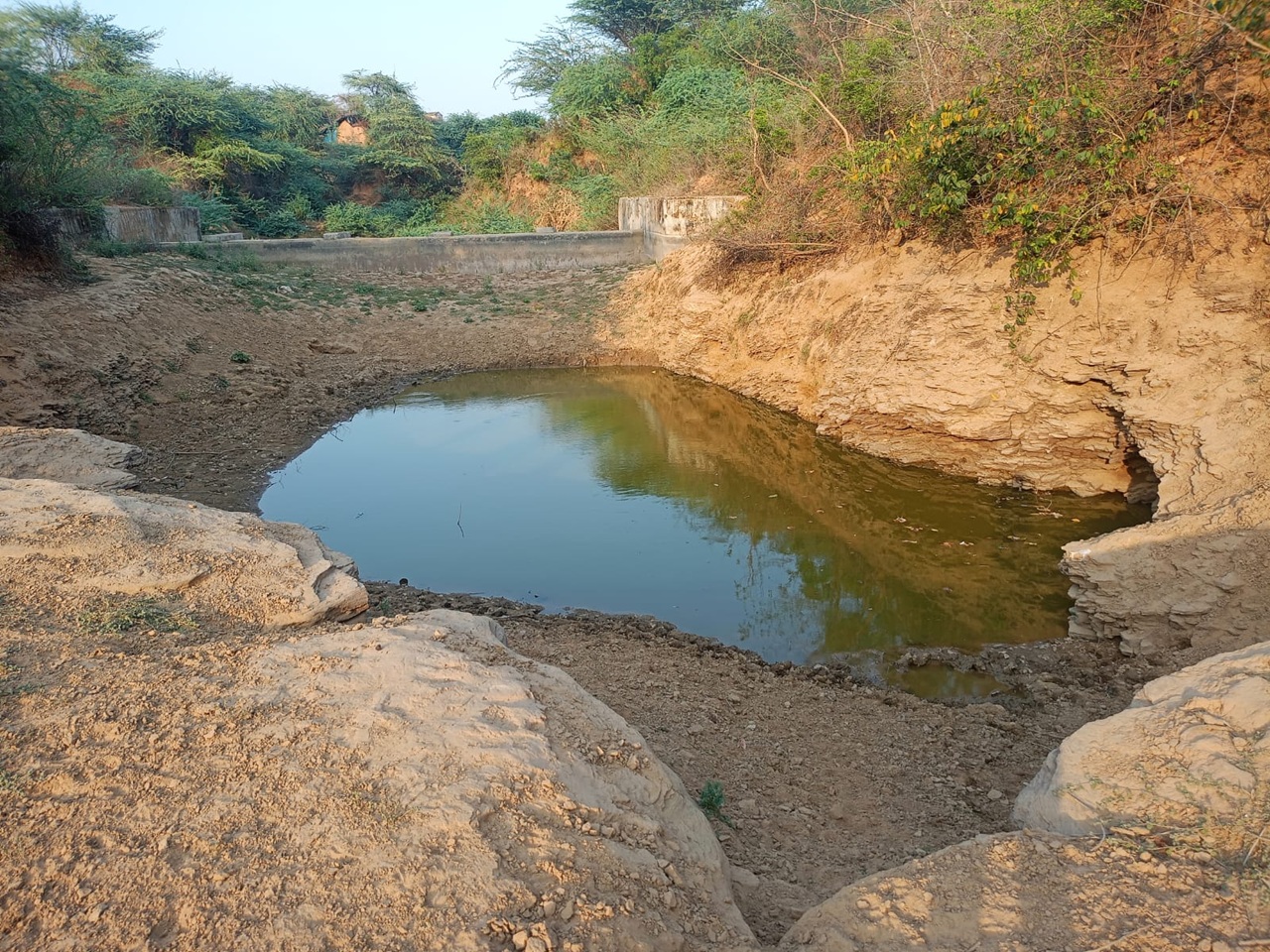 यह ब्रह्म कुंड कामदगिरि परिक्रमा मार्ग पर लक्ष्मण पहाड़ी से कुछ पहले है। फोटो - वॉटर वॉच
Follow Us: